The Northern Lights on Svalbard: Explained
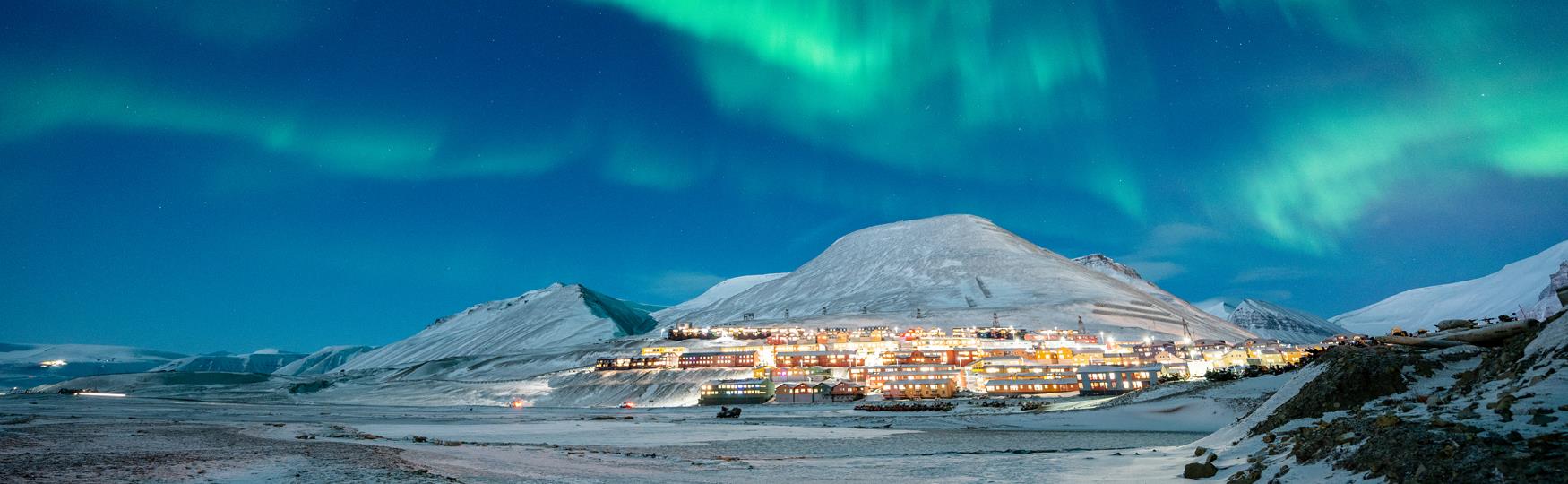
From October to February, the Northern Lights are a constant companion in Svalbard. Veils of light drift across a landscape that is as unforgiving as it is beautiful – and the sight never loses its ability to impress. What is unique is that Longyearbyen is one of the few places in the world where you can actually see the Northern Lights in the middle of the day.
So yes – we understand those who want to nerd out about this phenomenon. This article is written precisely for you, with some extra insights into how this legendary light is really formed.
Content scientifically reviewed by: Jøran Moen, UNIS
Why do the Northern Lights occur?
Both the Earth and the Sun have so-called magnetic fields, and both play important roles in the formation of the aurora.
It all starts with the Sun. The Sun is essentially a hydrogen bomb and our most important source of energy. It has an enormous and restless magnetic field, created by electric currents in the glowing, rotating plasma that makes up the Sun. As part of this process, the Sun continuously sends out a stream of tiny, charged particles – mostly electrons and protons. This ejecta is called the solar wind, and it carries magnetic fields from the Sun. Occasionally, solar storms occur when enormous magnetic gas clouds detach themselves from the Sun, carrying huge amounts of energy (Coronal Mass Ejection, CME).
When the solar wind reaches Earth, it encounters the Earth’s own magnetic field. Earth’s magnetic field acts as a shock absorber and protects us against the solar wind. On the Sun-facing side, the field is compressed, while on the night side it is stretched into a long tail. Without this magnetic shield, the solar wind would constantly bombard Earth, most strongly on the dayside at the equator.
This “magnetic shock absorber” is generated by the movement of liquid iron deep inside Earth’s core, forming an invisible magnetic shield that wraps around the planet.
But Earth’s magnetic shield has “weak points.” At contact points where Earth’s magnetic field and the solar wind’s magnetic field are oriented in opposite directions, the Sun’s magnetic field connects to the Earth’s magnetic field, and solar wind gas can slip into the Earth´s atmosphere. This process is called magnetic merging. When it happens, solar particles stream along the Earth's magnetic field into the top of the Earth’s atmosphere. Then they collide with gases and create the light phenomenon we call the Northern Lights – or aurora borealis.
What is the difference between daytime aurora and the aurora seen in the evening and at night?
Daytime aurora
On the dayside of Earth, near the magnetic poles, there are regions called the polar cusp. Here, Earth’s magnetic field connects to the solar wind magnetic field – almost like a funnel – which gives solar particles access to the top-side of Earth´s atmosphere.
This means that you can see the aurora even in the middle of the day in the northernmost regions during winter, such as in Svalbard. Between November and January, Svalbard experiences the polar night, when it is dark even at noon. This makes it possible to observe the daytime aurora with the naked eye. In the Southern Hemisphere, the same happens around Antarctica during its winter.
Daytime aurora is usually somewhat weaker and more diffuse than nighttime aurora.
Nighttime aurora
On the night side, the Earth’s magnetic field is stretched far out into a long tail. Energy and charged particles from the Sun accumulate there in the stretched magnetic tail, and after 2–3 hours of “charging” the tail, the Earth's magnetic field has been travelling over the poles, from day to night, and has been stretched like a rubber-band magnetic tail from 60,000 to 600,000 km. When it cannot hold more energy, reconnection occurs, and the solar wind magnetic field decouples from the overstretched Earth's magnetic tail. The Earth's magnetic field snaps back from 600.000 km to 60.000 km. Particles are flung toward Earth at high speed, collide with the atmosphere, and create the more colourful, intense aurora we most often see in the evening and at night.
In short:
On the dayside, aurora occurs when the solar wind’s magnetic field connects with the Earth’s magnetic field, letting particles in directly – creating the daytime aurora. On the nightside, aurora occurs when solar wind disconnects from the Earth´s magnetic field, and the enormous amount of stored energy in the magnetic tail is suddenly released – producing the stronger, more colourful aurora seen in the evening and at night.

The aurora’s color palette
The aurora can glow in several colours, depending on which gases the solar particles collide with, and at what altitude:
- Green – the most common colour, produced when particles hit oxygen 100–300 km above ground.
- Red – rarer, produced when oxygen is hit at even higher altitudes, above 200 km.
- Blue and purple – produced when particles collide with nitrogen in the lower atmosphere.
Put simply: Different gases + different altitudes = different colours. This is why aurora can shift from green to red or purple in the same display.
What is the auroral oval?
The aurora doesn’t appear randomly in the sky – it follows Earth’s magnetic field, which guides solar particles toward the poles. When particles hit the atmosphere, they create a kind of belt of aurora that encircles the magnetic poles. This belt is called the auroral oval, and it exists in both hemispheres.
In the Northern Hemisphere, the oval lies like an invisible ring across the Arctic, covering northern Norway, Finland, Sweden, Russia, and Svalbard. In the Southern Hemisphere, a similar oval lies over Antarctica, where the aurora is called the Aurora Australis.
Svalbard is located slightly north of the main auroral oval, which means the aurora here is often weaker and more diffuse than further south in the oval.
The size and position of the oval constantly change with solar activity. When the Sun is very active, the oval expands southward, and aurora can be seen even far into mainland Europe.
Can the aurora affect technology?
Yes. Strong geomagnetic activity can disturb navigation, radio signals, and satellite systems. Solar storms and CMEs can cause GPS errors, disrupt aviation, and lead to radio blackouts – a reminder that aurora is more than just a beautiful light show.
There is enormous electrical energy in aurora, and several times, solar storms have disrupted systems we take for granted. For example, in March 1989, a strong geomagnetic storm caused the Hydro-Québec power grid in Canada to fail, leaving 6 million people without power for nine hours. In November 2015, a solar flare disrupted Swedish airspace by interfering with radar systems, forcing the closure of airspace for over an hour.
How is the Aurora forecasted?
Today, many apps allow enthusiasts to follow aurora activity. They use real-time data from satellites measuring the speed, density, and strength of the solar wind. Important indicators include:
- Kp index (0–9): Higher numbers mean stronger geomagnetic activity, increasing chances of seeing aurora further south.
- Bz component: When it points southward, Earth’s magnetic field opens up, allowing more solar particles in.
- Coronal Mass Ejections (CMEs): Large solar eruptions that can create aurora days later.
Ground-based magnetometers are also used to detect rapid changes in Earth’s magnetic field, giving near-instant alerts that aurora is happening.
But forecasts aren’t everything – you also need clear skies. In Svalbard, Yr.no is your best friend for checking the weather.
If you want to maximise your chances, join a local guide in Longyearbyen. They know the landscape, the best viewing spots, and are skilled at interpreting forecasts and apps.
A small bonus
Want to dive even deeper? Here’s an explainer video that covers the formation of aurora in detail: Why do the Northern Lights occur? https://www.youtube.com/watch?v=3Oy4Mr6c6-0



.png)
.png)
.png)