In Svalbard, the seasons are full of contrasts and more intense than almost anywhere else on Earth. Here, it’s not just about weather and temperature – it’s about light. And darkness. And everything in between. This Arctic Archipelago, situated between mainland Norway and the North Pole, offers some of the world’s most unique light phenomena. The year shifts between the darkness of the polar night and the constant daylight of the midnight sun, but it is in the transitions – when the light disappears or gradually returns – that Svalbard shows itself at its most spectacular. Here, light is more than something you see – it’s something you feel. And that alone is worth the journey to 78 degrees north.

Dancing Northern Lights and the Beautiful Blue Hour
When darkness settles in October and lasts until mid-February, Svalbard enters a season unlike any other. A long, tranquil period marked by starry skies, pastel twilight, and dancing northern lights. This is what we call the Northern Lights winter. In the heart of this season, from November 14 to January 29, it is the polar night. The sun remains more than six degrees below the horizon all day, and daylight never comes. Night and day blend, and it is precisely this deep darkness that offers excellent conditions for seeing the aurora – even in the middle of the day.
For those travelling to Svalbard hoping to see the northern lights, it’s worth knowing that the archipelago lies north of the most active part of the auroral oval. This means the light is often more subdued and gentler than dramatic – but perhaps all the more beautiful for it. Like a quiet performance, just for you. At the same time, there is no guarantee of seeing the northern lights. They may appear, or they may keep you waiting. Perhaps they show themselves as you drive a dog sled through desolate valleys or take a short mountain hike with views over Longyearbyen. The perfect finishing touch. And then, the most beautiful of all: at the start or end of the polar night, when the sun plays around the horizon, something truly special happens. A blue, almost unreal light settles over the mountains, and the sky is painted in soft pastel tones. The entire landscape takes on a dreamlike calm. The light from a sun you cannot yet see begins to awaken the world again. Some call it the blue hour, others the twilight period. Whatever the name, it is in this transition between light and dark that Svalbard is at its most atmospheric.
Sunbeams Over Snow-Covered Mountains
Then, at the end of February, the sun returns after several months of darkness. It happens gradually, as if fumbling its way back after a long break. This marks the beginning of the sunny winter, a time that stirs both body and mind into motion. On mainland Norway, the period from March to May is called spring, but that concept makes little sense on Svalbard. Here, it is still full winter, with snow-covered landscapes as far as the eye can see. But the contrasts are great. In early March, it can still be twilight at midday, while by the end of April there is continuous daylight.
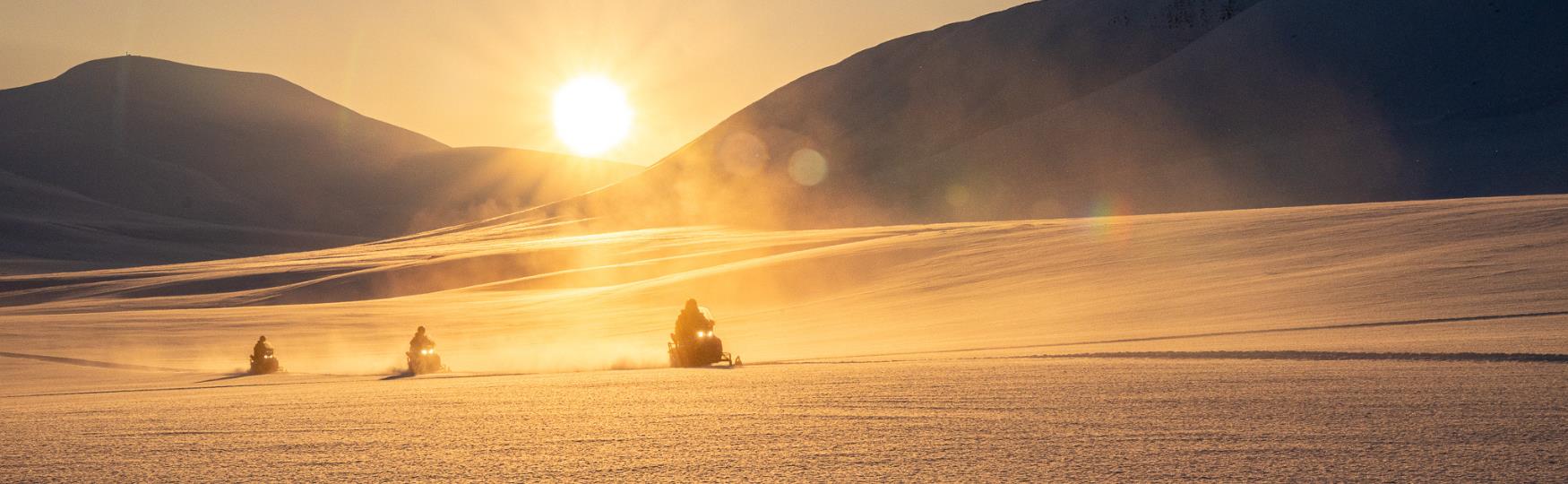
On April 20, the midnight sun makes its arrival. There’s no turning back now. The soft, golden light transforms the landscape from day to day – like a painting in motion. The local population also comes to life again. Snowmobiles shoot out of town with plumes of snow in their wake, and dog teams race through valleys and across frozen fjords. The light carries us for miles, and everything feels possible.
A Sun That Refuses to Set
Between the sunny winter and the polar summer, the transition is quick, and we are already getting used to a sun that refuses to go down. It hangs above the horizon around the clock, bathing the sea and tundra in a warm glow. The feeling of an unbroken day is overwhelming. You can hike in the mountains with sunglasses long after midnight or paddle between ice floes at three in the morning. When the sun stands just as high at midnight as at lunch, it’s easy to forget bedtime. But in late August, the sun sinks lower in the sky. The light softens, and the landscape changes character once more.
On August 23, the midnight sun disappears, and Svalbard enters what may be the archipelago’s best-kept secret – the golden autumn. In September, the tundra glows in shades of red, copper, and gold. Even the modest vegetation bursts into color against the clear, cool light. The mountains gain sharper contours, the air turns crisp, and the golden autumn sets a fitting finale to the year of light.
Experiences in Every Season
And so the year on Svalbard comes full circle, from polar night to midnight sun and back toward darkness again. Each season has its own light, its own atmosphere, and its own experiences. No matter the time of year, there are plenty of adventures to be found – both out in nature and indoors in the small Arctic metropolis of Longyearbyen. That’s why so many visitors return, time and again, while the locals look forward to the next change. Because each season has its own uniqueness, shaped and colored by the light.
FACTS
Twilight
On Svalbard, you can experience the long twilight in October and February, when the sun lies between 0° and 6° below the horizon. This phase, called civil twilight, gives a soft and lingering transition between night and day. The light can be blue, pink, or purple, tinting the landscape in muted pastels. Source: https://en.wikipedia.org/wiki/Polar_night
Northern Lights (Aurora Borealis)
The northern lights occur when electrically charged particles from the sun hit the Earth’s magnetic field and collide with gas molecules in the atmosphere. This creates flashes of light and rippling patterns in the sky, often in green, pink, or purple. On Svalbard, you can see the northern lights both at night and in the middle of the day during the polar night. Sources: https://en.visitsvalbard.com/inspiration/various/10-things-about-the-northern-lights?utm_source=chatgpt.com
Polar Night
The polar night on Svalbard lasts from about November 14 to January 29. During this period, the sun remains more than 6° below the horizon all day, and there is never daylight – only twilight, moonlight, stars, and northern lights. Source: https://en.wikipedia.org/wiki/Polar_night
Midnight Sun (Polar Day)
The midnight sun on Svalbard lasts from about April 20 to August 23. During this period, the sun never sets, and it is light 24 hours a day. The light changes throughout the summer, from cool and clear in the beginning to warm and golden towards late summer. Source: https://no.wikipedia.org/wiki/Midnattssol


.png)
.png)
.png)