Svalbard is an Arctic destination where nature sets the terms. To ensure a safe, responsible, and memorable stay, good preparation is essential. Here you will find the most important information you need before and during your trip - from travel documents and insurance to clothing, safe travel practices, and local guidelines. By preparing well, you contribute to both your own safety and the protection of Svalbard’s fragile environment and local community.
Once you’ve read this information, you should be able to tick off all the boxes below:
Check list for all travellers to Svalbard
✔ |
I have a valid passport or ID card |
✔ |
I have valid travel and health insurance |
✔ |
I have appropriate clothing for the Arctic climate |
✔ |
I have booked activities with approved operators |
✔ |
I am familiar with the light conditions and the seasons |
✔ |
I have familiarised myself with the importance of environmental protection, polar bear safety, and safe conduct |
✔ |
I have read the Longyearbyen Community Guidelines |
✔ |
I have read the Svalbard guidelines for safe travel |
About Svalbard
Svalbard is an Arctic archipelago located between mainland Norway and the North Pole. The largest settlement is Longyearbyen. Svalbard is part of the Kingdom of Norway and is governed by special regulations under the Svalbard Treaty.
The nature is wild, infrastructure is limited, and conditions can be demanding. Thorough preparation is crucial for a safe and successful journey.
Weather and climate
Svalbard has an Arctic climate year-round. The weather can change rapidly, and conditions may become challenging on short notice. Winter lasts from October to May, and temperatures can drop below –30°C (–22°F). Wind can significantly lower the perceived temperature.
Summer lasts from June to September. Temperatures typically range between 0 and 10°C (32–50°F), but it can still be cold and windy. Read more about clothing here.
Midnight Sun and Polar Night
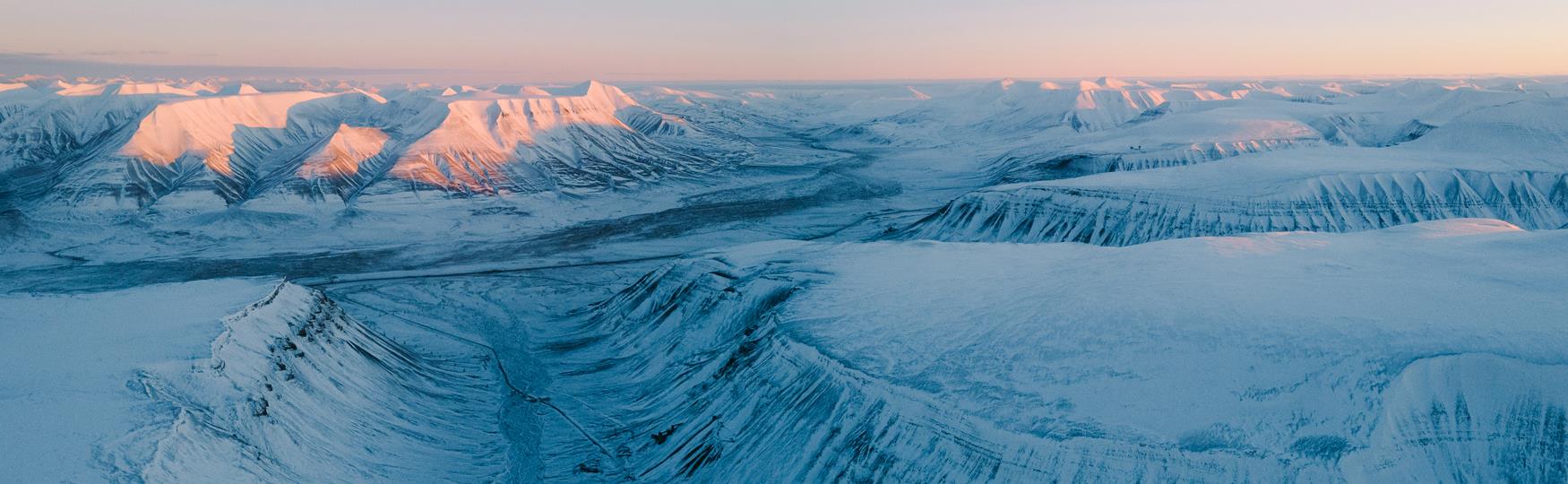
The Dark Season on Svalbard lasts approximately from late October to mid-February. Between 14 November and 29 January, Svalbard enters the darkest and coziest part of the season, also known as the Polar Night, with darkness 24/7. Remember to wear reflectors for your own and others’ safety.
The Midnight Sun refers to the phenomenon where the sun remains above the horizon 24 hours a day. This occurs both north of the Arctic Circle and south of the Antarctic Circle. The Midnight Sun arrives in Longyearbyen on 19 April and lasts until 23 August. Read more about the seasons in Svalbard here.
Accessibility
Although Svalbard is not subject to the same universal design regulations as mainland Norway, there is a varied range of offers that make it possible for visitors with special needs to enjoy a memorable and comfortable experience here. Read more here.
Traveling to Longyearbyen and Svalbard
Valid travel documents for Svalbard
All travellers to Svalbard must carry valid travel documents. A passport is accepted as a valid travel document for entry to Svalbard. Norwegian national ID cards and documents listed in Appendix 4 of the Immigration Regulations are also accepted.
There is no requirement for validity beyond the date of entry. However, we recommend that your travel document remains valid for a period after your planned departure.
Schengen Visa
Norwegian authorities do not require a visa for entry to Svalbard. However, travelling to Svalbard requires a visa for mainland Norway/Schengen with permission for double entry.
Flights to and from Svalbard
Svalbard has one airport: Svalbard Airport, Longyear (LYR). You can only travel to Svalbard via Oslo or Tromsø. Several flights from Oslo include a stopover in Tromsø. A stopover in Tromsø means you must disembark the aircraft, bring your carry-on luggage, go through passport control and security screening, and then proceed to the gate for your onward flight. If you have checked baggage, it must be collected and rechecked on your return journey via Tromsø. Whether your baggage is checked through automatically or must be rechecked depends on your ticket and airline.
Travel and health insurance
Anyone travelling to Svalbard should have valid travel insurance covering the entire stay, including:
- Medical treatment
- Potential transport to the mainland
- Unforeseen incidents
- Medical evacuation
You must check with your insurance provider that your policy covers Svalbard. Not all standard travel insurance policies cover travel to the Arctic.
Standard travel insurance normally does not cover search and rescue (SAR) operations. Organised local tour operators include SAR insurance in the price of booked activities. If you plan to travel independently outside Management Area 10, you are required to apply for permission and obtain SAR insurance through the Governor of Svalbard.
Protecting nature and safe travels in Svalbard
Svalbard is a vulnerable Arctic region with some of the world’s strictest environmental regulations. The purpose of these rules is to preserve a largely untouched environment, including landscapes, flora, fauna, and cultural heritage. It is prohibited to pick plants or disturb wildlife, and all cultural heritage sites dating from before 1946 are automatically protected and must not be touched. Many newer cultural heritage sites are also protected by specific regulations. All travel must be conducted with great care, and there are strict rules governing activity in protected areas.
Svalbard is Arctic wilderness, and travelling outside settlements involves real risk. Knowledge, experience, thorough planning, and careful risk assessments are essential.
Familiarise yourself with the Svalbard Guidelines (Svalbardvettreglene), which provide concrete advice on both environmental responsibility and personal safety. We also strongly encourage the use of organised and approved tour operators.
Read the Svalbard Guidelines here.
The Governor of Svalbard is responsible for administering environmental regulations and provides detailed information on environmental protection, travel, and obligations for both residents and visitors.
Read more from the Governor of Svalbard here.
Svalbard Environmental Protection Fund
All travellers to Svalbard must pay an environmental fee of NOK 150 to the Svalbard Environmental Protection Fund. This fee is automatically included in the price of airline and cruise tickets.
The fund was established to preserve and protect the archipelago’s rich natural environment and unique cultural heritage. Read more here.
Polar bear safety
The risk of encountering polar bears exists everywhere on Svalbard, year-round.
According to Section 30a of the Svalbard Environmental Protection Act, anyone travelling or staying outside inhabited areas must have knowledge of polar bear safety and carry suitable deterrents to scare away polar bears. Exceptions apply to participants in organised tourism activities.
We therefore recommend that all visitors wishing to experience Svalbard’s wilderness join organised tours with local activity providers in Longyearbyen. Local guides have the necessary experience and knowledge to assess and manage polar bear risks.
Polar bears are fully protected on Svalbard. It is prohibited to disturb them, lure them, or pursue them unnecessarily, and minimum distance requirements apply. Unlike some other destinations, organised tours specifically aimed at seeking out polar bears do not exist on Svalbard - there are no “polar bear safaris.” Read more here.
Why choose guided tours
Joining guided tours is the safest and most responsible way to experience Svalbard. Guides are highly qualified and experienced in assessing weather conditions, avalanche risk, ice conditions, polar bear threats, and other risk factors. They always carry equipment for even the most demanding situations, including satellite phones and emergency beacons, avalanche and rescue equipment, first aid kits, tents, heat sources, food, and drinks. Read more here.
Proper clothing
When visiting Arctic Svalbard, proper clothing is essential. Weather conditions change rapidly throughout the year in the High Arctic, and strong winds can make temperatures feel much colder than they are. The terrain consists largely of tundra and rocky ground, so sturdy, waterproof footwear or hiking boots are necessary for travel in the wilderness. Read more about clothing here.
Staying in Longyearbyen
Longyearbyen Community Guidelines
We have developed community guidelines we ask visitors to follow. By doing so, you contribute to more sustainable tourism that respects the fragile Arctic environment, other visitors, and - most importantly - the local community. See the full guidelines here.
Drone restrictions
The use of drones is prohibited in Longyearbyen. The ban applies within a five-kilometre radius of the airport. If you plan to fly drones outside the restricted zone, you must familiarise yourself with applicable drone regulations. More information can be found here.
Payment and currency
The currency used on Svalbard is Norwegian kroner (NOK), and currency exchange is not available. There are no banks or ATMs in Longyearbyen, so shops, restaurants, and hotels generally prefer card payments over cash. Almost all cards are accepted. Svalbard is a tax-free zone, meaning all purchases are VAT-free.
There are special regulations for alcohol sales on Svalbard. Tourists may purchase alcohol at Nordpolet upon presentation of valid ID and a boarding pass.
Mobile coverage and internet
There is good mobile coverage in Longyearbyen, and many restaurants, shops, and hotels offer WiFi. Several mobile networks operate on Svalbard. In Longyearbyen and surrounding areas, Telenor Svalbard provides mobile and data services. Russian settlements also have their own mobile network. Which network your phone connects to depends on your location and service provider.
Because Svalbard is not part of the EU/EEA, standard EU roaming rules do not apply. Depending on your mobile plan, connections may be considered international roaming, resulting in significantly higher costs for calls, messages, and data. We recommend checking your phone settings and your provider’s terms to avoid unexpected charges.
Outside settlements, coverage is limited or non-existent. On longer trips outside settlements, satellite communication is recommended. On organised tours, guides always carry this equipment.
Here are five simple tips for mobile phone use on Svalbard.
Transport on Svalbard
The road network in Longyearbyen is very limited, and there are no roads connecting settlements on Svalbard. All transport between Longyearbyen and other locations (such as Isfjord Radio and Ny-Ålesund) takes place by snowmobile, boat, or aircraft.
The airport shuttle bus always corresponds with flight arrivals and departures, and stops at all accommodation facilities.
There are two taxi companies in Longyearbyen, both operating 24/7. During the summer season, bicycles can be rented for use within the town limits.
Distances within Longyearbyen are short, making it easy to get around on foot. You can find a town map here.
Driving licences
To operate a snowmobile or ATV on Svalbard, you must hold a valid driving licence. A category B (passenger car) licence is accepted. For snowmobiles, licences in categories A, A1, A2, or S (snowmobile) are also accepted.
The licence must be issued by a country that is a party to the 1949 Geneva Convention or the 1968 Vienna Convention on Road Traffic. Digital licences are only valid if issued in Norway. All licences from EU/EEA countries meet these requirements.
If your licence is issued outside the EU/EEA, you must check whether it complies with the model requirements of one of the conventions. If it does not, you must carry additional documentation as described here.
Health and emergency services
Longyearbyen Hospital is a public emergency hospital handling primarily acute incidents and basic medical treatment.
If further treatment is required, patients must be transported to the mainland. Such transport may be weather-dependent and involve additional costs.
We strongly recommend having valid travel insurance that covers your stay on Svalbard, including medical care and unexpected incidents.
Experiences in Longyearbyen
Longyearbyen offers a wide range of cultural experiences, dining options, and activities. We recommend exploring museums, restaurants, and the surrounding area through guided tours:
Other settlements in Svalbard
Barentsburg and Pyramiden
There are two Russian settlements on Svalbard. Barentsburg is an active Russian mining community located in Grønfjorden, west of Longyearbyen, and is operated by the state-owned company Trust Arktikugol, with a year-round population.
Pyramiden is a former Soviet mining town located by Billefjorden. Mining operations ceased in 1998, and most residents left the settlement. Like Barentsburg, it is now operated by Trust Arktikugol.
Russia’s war in Ukraine also affects life on Svalbard due to the proximity of the Russian settlements Barentsburg and Pyramiden.
In 2022, the conditions for cooperation between tourism operators in Longyearbyen and Barentsburg changed. Following Russia’s invasion of Ukraine and the associated violations of international law and human rights, an extraordinary general assembly of Visit Svalbard decided to remove all products, trips, services, or offers with any connection to Russian state-owned companies on Svalbard from Visit Svalbard’s platforms.
We kindly ask visitors for their understanding. Visit Svalbard therefore does not currently market or sell trips to Barentsburg and Pyramiden through our channels. More information can be found here.
Ny-Ålesund
Ny-Ålesund is an international research community and one of the world’s northernmost year-round settlements. Today, it is used exclusively for research and environmental monitoring, with scientists from many countries studying climate, the atmosphere, and Arctic ecosystems.
Ny-Ålesund is not a regular tourist destination, and independent travel is not permitted. Visits are only possible through organised tours.
In summer, Ny-Ålesund can be visited as part of guided day trips by boat from Longyearbyen or through expedition cruises that include Ny-Ålesund as a port of call. All travel and activity are strictly regulated to protect research, the environment, and safety.


.png)
.png)
.png)