In a world that rarely pauses, where experiences are captured, shared and measured in an instant, a few places still choose a different pace. Svalbard is one of them. Here, life unfolds more quietly. You slow down without really noticing it at first. The silence draws you in, the light shifts around you, and you begin to take in your surroundings with more than just your eyes. What many of us who live here call the “Svalbard pulse” isn’t something you plan for. It’s something you fall into. It aligns naturally with the idea of slow tourism, not as a concept, but as a way of being. Because travelling slowly isn’t about doing less. It’s about allowing time. Time for places to reveal themselves, for encounters to deepen, and for moments to arrive without being rushed.

In Svalbard, this way of travelling feels less like a choice and more like a necessity. Nature, light and weather set the terms. A snowstorm may disrupt your plans, yet open a small window of stillness. A quiet evening can suddenly shift into something extraordinary, as the northern lights sweep across the sky. And before you know it, you’re standing there, sharing the moment with people who were strangers just hours ago. You come to realise that the journey was never yours to control. You’re simply part of it. And it is there, in the pauses, in the unpredictability, that something shifts. That’s where the magic lives.
This is what the Svalbard pulse feels like
It takes a few days to notice it – the quieter rhythm that slowly begins to shape your time at 78 degrees north. At first, you might resist it. Then, almost without realising, you adapt. Things take the time they take. The weather decides, flights leave when they can, and the light follows its own logic. Eventually, you stop checking the time.
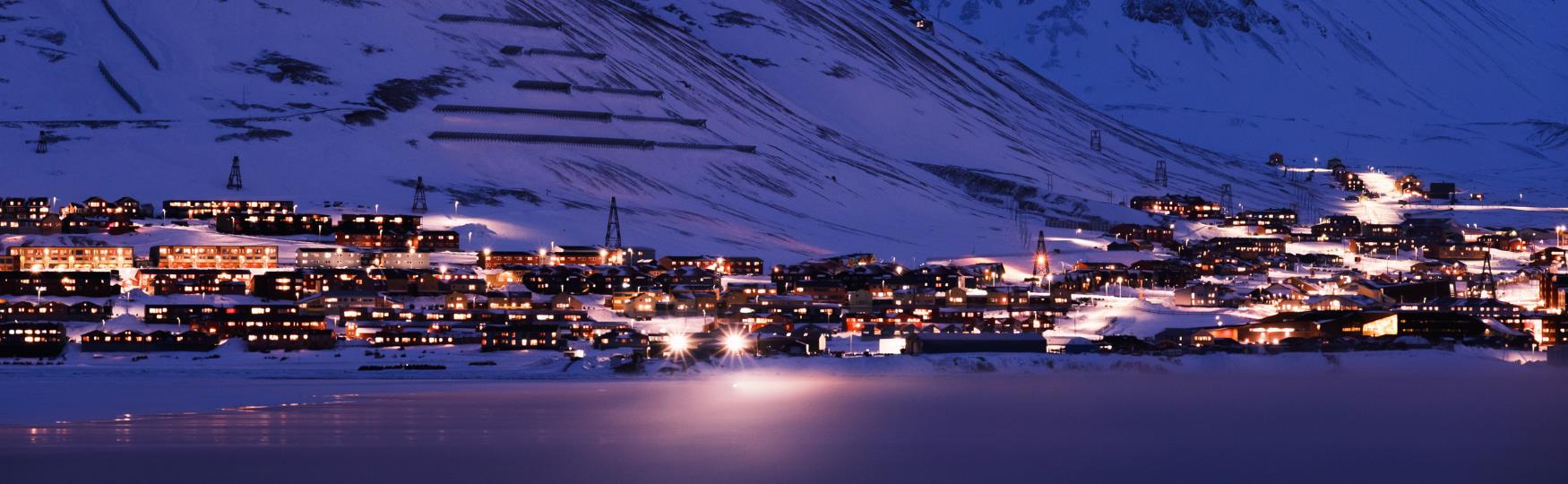
In Longyearbyen, the calm is almost physical. Perhaps because everything is so close. A handful of streets, a small community where people know each other, and very little that demands your urgency. There are no queues to navigate, no traffic to escape, nowhere you have to be at a certain hour. Beyond the last buildings, the landscape takes over. Silence stretches out in every direction. The mountains rise sharply around the town, like a natural amphitheatre, and beyond them lie glaciers, wilderness and the North Pole itself. It gives you perspective and a quiet reminder of how little is needed to feel fully present.
For many, this is where Svalbard leaves its deepest impression: in the contrast between a small, close-knit community and a vast, overwhelming landscape. And yet, Longyearbyen is anything but empty. There is warmth here, in every sense of the word. After a day outdoors, people gather to thaw out, to share stories, to eat well. You sit in wool layers and thick socks, a cup warming your hands, as conversations drift easily from one table to another. No one seems in a hurry.
In summer, the midnight sun stretches time beyond its usual limits. Evenings dissolve into nights that never quite arrive, and sleep begins to feel optional. The light itself becomes an excuse to stay just a little longer. In winter, the rhythm becomes even more distinct. When the sun disappears, and the world settles into deep blues and soft darkness, something shifts. The outside world grows quieter. Time slows further. This is when you feel it most clearly, the Svalbard pulse.
Meaningful experiences
Outdoor activities on Svalbard are often associated with speed and adrenaline – and many of them certainly deliver. A snowmobile ride across the sea ice, a RIB journey through drifting ice, or a hike with views of bright blue glacier fronts will get your pulse racing. But what sets these experiences apart is what follows. When the engine falls silent. When the wind settles. When you find yourself standing in the stillness that was there all along, quietly waiting. Like sitting behind a team of sled dogs as the clouds suddenly lift. The landscape opens without a word, and all you hear is the steady rhythm of breath and the soft glide of runners over snow. Nothing more is needed.
You feel it again beneath the surface, stepping into an ice cave. A hidden world, carved slowly by meltwater through ancient glaciers. Layer upon layer of ice surrounds you, shaped over centuries. It feels less like entering a cave, and more like stepping into something time itself has created – patiently, over generations. Even a simple hike carries the same sense of calm. It’s not about distance or elevation, but about staying long enough to notice the small shifts – the light moving across the landscape, the wind changing direction, a ptarmigan quietly crossing the tundra. Here, the journey isn’t about reaching somewhere else. It’s about being exactly where you are.
And back in Longyearbyen, the rhythm continues. At SvalBad, steam rises around you as the cold sea waits just outside – a place for warm conversations and flushed cheeks. Or you might find yourself at Nordover, surrounded by Kåre Tveter’s soft, luminous interpretations of Svalbard light. It lingers long after you leave.
Stay longer – and be more present
Travelling slowly on Svalbard isn’t about doing less. It’s about being more present. The difference often lies in the small choices, the ones that shape how you experience a place. Stay a little longer, and allow yourself to notice how everything shifts. The light changes almost constantly. The weather rewrites the landscape from one hour to the next. Sounds come and go, until even silence begins to feel like something you can hold onto.
- We recommend giving yourself at least five days in Longyearbyen, not to fill your schedule, but to allow impressions time to settle.
- Choose to explore with local guides. Not just for where they take you, but for what they share along the way. The stories, the knowledge, the quiet insights that bring meaning to what you see and help you understand what might otherwise pass unnoticed.
- Take a moment to observe, rather than move through. Respect the nature, the wildlife, and the people who live here. Let their perspective shape your own. Learning the place slowly, as it unfolds, is part of the experience.
- And perhaps most importantly: slow down. Put your phone away. Listen to the silence. Let Svalbard do what it does best, and change your pace, without asking.
Slow tourism is rooted in a simple idea: to travel more slowly, more consciously, and with enough time for places to leave an impression. Instead of moving quickly from one experience to the next, it’s about staying longer in fewer places. Taking time to understand the landscape, the people and the rhythms of daily life, and allowing the journey itself to set the pace. It’s as much about presence as it is about sustainability. About choosing depth over distance, quality over quantity. And about experiencing a place in a way that leaves lasting memories, without leaving a lasting mark.


.png)
.png)
.png)