Accessible Polar Night
The plane lifted off from Oslo at dawn, with rain hanging in the air and an entirely ordinary start to a thoroughly extraordinary journey. Three hours later, I was surrounded by complete darkness, and upon landing, there was no horizon to be seen. The mountains were almost invisible, and the landscape dissolved into black. The only signs that I had arrived were the lights of the airport and the sight of Longyearbyen, appearing like a glowing ribbon of warm light in the darkness.
Travelling to Svalbard during the polar night is not just about the absence of light. It changes the pace, sharpens the senses, and alters the way you orient yourself. Svalbard is the only place in the world where tourists can experience a full polar night for several months, when the sun remains more than six degrees below the horizon around the clock. What remains is silence, paired with a heightened awareness of your surroundings.
I arrived in this landscape on crutches, curious to see how things would work in practice. On Svalbard, accessibility is less about universal design and more about a willingness to find solutions in an environment where nature sets the limits.

Longyearbyen in practice
At the airport, assistance was waiting at the bottom of the aircraft stairs or via a lift if pre-booked. The ground outside the plane was icy, but the distances were short. It was roughly 100 metres from the aircraft to the terminal building, and a further 100 metres through the terminal, past the baggage claim, before stepping outside again, where the airport bus and taxis were waiting directly outside.
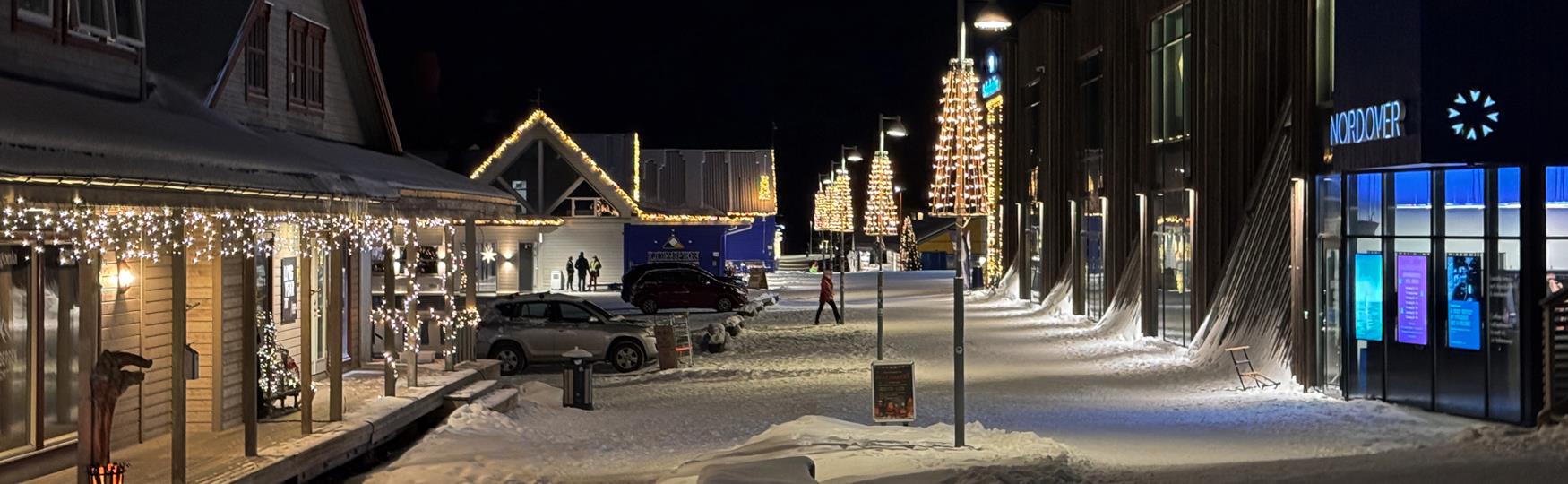
In Longyearbyen itself, I experienced the main street as well cleared and hard-packed, with a gentle slope running from the top of the street near Hotel Polfareren down towards the Radisson Blu. Both hotels can accommodate wheelchair users, with step-free entrances, ramps and lifts. The stretch is around 550 metres long, and the town felt welcoming, bathed in warm light and a friendly atmosphere that stood in contrast to the darkness beyond. With a compact selection of shops, restaurants and bars, it was easy to feel at home here.
I quickly noticed that many shops and entrances had low thresholds. Few places could be described as completely step-free, but most thresholds were manageable for wheelchair users, with or without assistance. During my stay, only one shop had several steps at the entrance, and in some places, small ramps can be used when snow conditions allow. Overall, I found that shops were accustomed to welcoming wheelchair users and offering a helping hand, something that reflects the summer cruise season, when Longyearbyen hosts many visitors with different access needs.
Lompen shopping centre is the best-adapted building in the town centre. It has three entrances: one with steps, one with a standard door, and one with automatic doors, as well as an accessible toilet. Inside, there is a lift discreetly located behind the staircase, providing easy access to the upper floor. Lompen also houses souvenir and sports shops, a café, a bar and a restaurant. A little further down the street is the Cultural Centre, with a library and café, automatic door openers and an accessible toilet.
I also quickly became familiar with a local custom found in hotels and some public buildings: the expectation that you remove your footwear indoors. This tradition dates back to the mining era when people wanted to avoid bringing coal dust inside. Most places provided seating to make this easier, but not everywhere.
Activities
During my days on Svalbard, I took part in a range of activities. Some offered powerful nature experiences with minimal physical strain, others involved movement within well-organised frameworks, while a few required more physical effort. What they all had in common was clear information and guides who were used to adjusting pace and execution along the way.
All the activities I joined started with pick-up from my hotel or nearby, and included return transport, changing facilities and necessary instruction. Transport was often by minibus, which generally lacked good handholds for boarding, but the guides were always helpful. If you plan to bring a folding wheelchair, this should be arranged in advance.
Before each activity, I was issued insulated winter suits to be worn over my own clothing, along with the necessary equipment. Seating was always available, making it easier to get dressed. Even with the suit, I found it essential to dress well underneath, as the activities involved extended time outdoors. Layering made it possible to regulate body temperature, and I quickly learned that once you get cold, it is difficult to warm up again. Bringing one extra layer more than you think you need is well worth it.
When moving in terrain beyond cleared roads, there was often some depth of snow underfoot. At the same time, I found that walking distances were kept to a minimum, and that most activities were centred around the transport vehicles. I did not feel that I missed out, even when remaining seated on a snowmobile or in a sled. There are also no toilets in the wilderness, which is worth keeping in mind.
Sightseeing with a local expert
A guided sightseeing tour by minibus provided a good overview of Longyearbyen and its surroundings. The tour lasted approximately two hours, and along the way the driver shared the town’s history, the surrounding landscape, and several key viewpoints and cultural landmarks. There were six stops in total, some involving a short walk from the minibus, while others could be enjoyed directly from the seat.
At the church, there is a lift to the second floor, and one of the stops also includes the Svalbard Global Seed Vault, built deep into the permafrost to safeguard duplicate seeds from around the world. Due to snow conditions that day, I had to walk about five minutes at a calm pace from the parking area, following vehicle tracks, as the bus could not drive all the way in.
The tour felt relaxed throughout, and it was clear how the pace and structure were adapted to the group. There are also vehicles available for wheelchair users that allow rolling directly in and out, but these must be booked in advance.
Northern Lights safari by snowcat
The northern lights safari by snowcat took me out of Longyearbyen, away from the town lights and into the landscape of Adventdalen. The snowcat had comfortable seating and was heated while driving, though I noticed that it took some time for the warmth to build up. As we stepped outside the vehicle for 10 to 15 minutes at each stop, it was important to be well-dressed and to have adjustable layers. We made four stops along the way to look for northern lights and reindeer. One stop was at a traditional hut, where hot drinks were served, and a fire was lit. To enter, you had to climb two pallet steps and cross a threshold.
Boarding the snowcat required climbing three relatively steep steps without handrails, but I used a ladder mounted on the outside of the vehicle. The floor near the entrance became slippery as ice formed by the door due to the cold, and during the drive, there was also constant vibration and some noise, which is worth being aware of.
A boarding ramp is available for manual wheelchairs, though it is worth noting that the door opening is 83 cm wide. Inside the snowcat, a wheelchair can be secured to the wall, or you can transfer to a standard seat with a safety belt. At stops, the snow cover is usually deeper than on cleared roads, which can make moving around on wheels difficult. Even so, it is possible to step outside the vehicle and experience the northern lights, the star-filled sky and the surrounding landscape.
Northern Lights evening at Camp Barentz
Camp Barentz is located out in Adventdalen, surrounded by open terrain. Its location makes it well-suited for viewing the northern lights, and the evening was spent in a traditional hut where dinner was served. Throughout the evening, the hosts shared stories from Svalbard and gave talks about the northern lights. Inside the hut, the meal was served at tables and benches without backrests. Even with a fire, it could feel cool indoors at times, and extra layers were useful, especially as I stepped outside several times to scan the sky.
The bus to the hut had seven high steps, which became slippery from the snow on the shoes, though there were places to hold on when boarding. From the bus, it was about a two-minute walk, roughly 200 metres, along a cleared path. Access to the hut itself was largely step-free along wide wooden planks, though there were gaps in the walkway that could be hidden under snow. The entrance also had a threshold, and the toilet was an outhouse with three steps and no handrail. At the end of the evening, I was picked up right outside the hut for the return journey.
Sled tour by snowmobile
Riding in a sled pulled by a snowmobile through Adventdalen was a comfortable way to experience Svalbard’s winter landscape. It was striking how quickly my eyes adjusted to the darkness, and how the mountains gradually emerged from the shadows. With moonlight and a star-filled sky, the experience felt especially powerful. Before departure, suiting up took place in a building at the starting point. To enter, I had to climb two narrow steps with a handrail on one side, followed by one additional step inside. The only toilet available was an outhouse with a couple of steps.
Along the route, we made several stops for photos and short stories, and the ride itself lasted roughly two hours. Getting in and out of the sled felt somewhat awkward, as it was relatively high, and a small step or stool would have been helpful, especially since there was only a handhold on one side. At the same time, the sled was very stable, and the speed never felt excessive. If arranged in advance, the sled can be positioned close to the changing building, avoiding a short descent across the road.
Dog sledding into Bolterdalen
Sitting in the sled behind the dog team and gliding into Bolterdalen while the landscape lay hidden in darkness around me was a unique experience. The only sounds were the sled gliding over the snow and the sight of wagging tails ahead, illuminated by a headtorch.
The experience began with changing clothes at the expedition centre, where you had to climb one step and cross two thresholds to enter. From there, I was driven to the dog yard, where eighty huskies were waiting, all secured on lines. Toilets at the expedition centre were only available on the second floor, but at the dog yard, there was a solid toilet building with three low steps. The area had cleared and compacted ground and good spacing between the dogs, making it possible to move around without direct contact if you were unsure at first. Some of the dogs were initially wary of my crutches, but once I became familiar with them, everything went smoothly.
Before departure, I received a thorough briefing on how the tour would proceed, even though I would only be a passenger. Unless otherwise arranged in advance, guests are expected to help harness the dogs, which requires good balance and strength.
The ride itself also required balance and leg strength, with hands placed on a front handhold and one foot used to operate the brake. In some sections, the surface was uneven, and on uphill stretches, you might need to assist the dogs by pushing. The sled had a backrest and side handholds, the speed felt controlled, and I never felt unsafe. The dog sledding itself lasted just over an hour, with several stops along the way to check on everyone and to switch between driving and riding.
Northern Lights safari by snowmobile
Riding through the polar night landscape on a snowmobile felt liberating, with darkness close around and the terrain opening up in the beam of the headlight. We stopped several times along the way, letting the silence settle and listening to short stories about the area. At one point, a reindeer moved through the darkness, and while I stood holding a warm drink, the northern lights appeared overhead.
Getting onto the snowmobile was easy, as it sits low on the snow. The step up was small, and the seat was wide and stable. When I drove myself, I sat without a backrest, with my legs planted on either side of the seat. Steering required some leg strength, and my upper body stayed in constant motion, helping to keep me warm along with the heated handlebars. The terrain felt relatively flat, and the ride was very manageable.
As a passenger, you sit securely behind the driver with a backrest and solid handholds by the thighs, though you are more exposed to the wind. The tour lasted approximately two hours in total. From the changing building, where access involved climbing stairs to the second floor and the toilets, there was a short but slightly steep slope down to the snowmobiles. If arranged in advance, transport can be provided down the slope.
Guided tour of Mine 3
The guided tour of Mine 3 offered an excellent insight into how mining has shaped both the community and the landscape of Svalbard. Wearing a helmet and headlamp, I moved into the mountain as the guide explained working conditions in the mine, and I could truly feel the temperature and confined space.
At the entrance to the main building, there were a couple of steps, and inside, you moved through several rooms with single step level changes. The introduction room had seating and toilets, and this was also where protective suits were put on before continuing.
The tour formed a route of just over two kilometres and was conducted at an adapted pace, with several stops along the way. The first section involved approximately 500 metres along a completely flat and stable wooden ramp, followed by a small platform with two steps.
From there, the route continued into the mine itself, where the surface consisted of compacted earth, rails, stones and uneven ground. The distance inside the mine was about 800 metres one way, with a height difference of 20 metres, which could be felt on the return. The temperature in the mine is about -2 degrees Celsius year-round.
Inside the mine, just before turning back, there was the option to crawl into a narrow working space to experience the conditions in which the work took place. This involved climbing seven ladder steps and then crawling forward, and was entirely optional. For those who chose not to do this, a couple of chairs would have been beneficial while waiting.
The Cabelway Central Station
The Cableway Central Station offered a guided tour of just over one hour, focusing on Svalbard’s industrial history and the role of the cableway in coal transport. From the area around the building, I had another fine view over Longyearbyen.
To reach the exhibition area, I had to climb 26 steps and cross a small threshold. Once at the top, the space was largely flat, tidy and compact, making it easy to move around. The tour was conducted at a relaxed pace with several stops. Seating was limited, and I missed having chairs available when the guide paused to speak. The temperature felt low, and it was effectively as cold inside as outside.
Svalbard Museum
I found the Svalbard Museum varied and engaging, without the information feeling overwhelming. The museum is located just behind the Radisson Blu, and the route there involves a fairly steep downhill stretch of about 210 metres. For me, a taxi felt like a suitable alternative.
The museum is housed in a modern building with automatic doors and largely step-free access. The only exception is a small hut within the exhibition, where you need to climb a couple of steps to enter. The exhibition is clear and well laid out, with several benches along the way. The total walking distance inside the museum is about 500 metres, and I spent between one and one and a half hours there at an unhurried pace.
Reflections
On Svalbard, there is no rush, no constant sense of needing to be somewhere else. Far from noise and bustle, the place feels like a rare pocket of calm, while still being exotic, energising and full of excitement. I understand why many of today’s residents originally came for a short stay, only to remain for many years.
I plan to return in daylight next time. I have been told that no two months are alike here, shaped primarily by continual changes in light and wildlife. Even so, the polar night will always hold a special place for me.
There is still room for improvement when it comes to accessibility, but I experienced Svalbard as a place defined by willingness and flexibility, with a clearly forward-looking approach to becoming a more inclusive destination.
If you wish to speak to Adele Heidenreich about her Svalbard experience, you can contact her via:
Phone: +47 46 29 71 78
Email: Heidenreich.EA@gmail.com
Website: www.EAHeidenreich.com
LinkedIn: linkedin.com/in/adeleheidenreich


.png)
.png)
.png)